Tag: EDI

  • Message of Solidarity with Transgender Women

    In recent weeks, several major organisations have decided to exclude transgender women from accessing their spaces and attending their events (including The Women’s Institute, The Girl Guides and Labour’s Women’s conference). This marks a radical reversal of previously established inclusive practices in these organisations and constitutes worrying precedents.

    The Women’s Institute began welcoming trans women in the 1970s and made their inclusion official in 2015.  Melissa Green, chief executive of the National Federation of Women’s Institutes commented that the organisation made it with the “utmost regret and sadness,” adding it had “no choice” but to exclude trans women from its membership.  It is alleged that legal challenges funded by J.K. Rowling’s “Women’s Fund”, from a small minority of members, forced the change.

    We are aware of how disconcerting this is for all the transgender members of our community, and their allies, as it is disconcerting to us as well. UCU has condemned the trans-exclusionary moves by the Supreme Court and EHRC.

    We stand in solidarity with transgender women and the transgender community generally. We are committed to working with university management to mitigate the impact of legislative changes to ensure our work and learning community remain inclusive for trans people. Please feel free to contact LUCU Equality Officer Angela Martinez Dy with any specific queries. She is committed to prioritising member engagement and raising concerns about forthcoming changes either individually or collectively. 

  • LUCU Response to University Comms regarding Higher Education (Freedom of Speech) Act and Supreme Court Ruling

    In light of this week’s communications from Sam McGinty (Director of Legal Services) and Veronica Moore (EDI Executive Director), the LUCU Equality Officer and Branch Committee would like to express their appreciation of the tandem statements being shared. We especially value the expressed commitment to humility, learning, consultation and inclusion, alongside upholding legal obligations. While the LUCU Committee was not consulted on the content of these statements in advance, the University has subsequently engaged in helpful discussion with us around them.

    Further, our Equality Officer, along with representatives from the other two campus Unions, Unite and UNISON, will contribute to this ongoing dialogue at the EDI Board (the main governance structure for EDI) from September 2025; in recent years only one Union rep was permitted per meeting. 

    We will use both formal and informal processes to understand these policy developments and anticipate how they will affect our members. We have also requested to be more closely included in decision-making on these issues going forward, including in the preparation of communications and guidance documents.

    While we understand the difficult legal position HEIs now face, we are nevertheless disappointed that the University finds itself no longer able to take a position on important matters, such as the genocide currently being carried out against Palestinians in Gaza and recent trans-exclusionary moves by the Supreme Court and EHRC – both of which UCU condemns.

    Please feel free to contact LUCU Equality Officer Angela Martinez Dy with any specific queries. She is committed to prioritising member engagement and raising concerns about forthcoming changes either individually or collectively.

  • When the State Defines Womanhood, We All Lose: LUCU Responds To UK Supreme Court Ruling

    The LUCU Committee is deeply concerned about the impact of the recent UK Supreme Court ruling that the protected characteristic of Sex within the Equality Act 2010 refers to ‘biological’ sex as recorded at birth, and not lived gender. The ruling stipulates that this even applies to individuals who have obtained a Gender Recognition Certificate, which effectively excludes transgender individuals from protection against sexism they might suffer in their lived gender.   

    As a small and vulnerable community, trans people are being used as an easy first target in a wider backlash against progressive ground gained internationally for women and LGBTQIA+ people. Ironically, although the campaign was led by women, the outcome problematically pits cis women against trans women, and lesbian, gay and bisexual people against trans people, who should, we believe, be natural allies in the fights against sexism, misogyny and homophobia. 

    The legal challenge which led to this ruling did not arise in a vacuum, but was the result of a series of  

    legal challenges brought by the campaign group For Women Scotland (FWS) and funded by author JK Rowling. By insisting ‘biology is destiny’, these arguments not only deny the legitimacy of trans experiences, and trans women in particular, but also hold the potential to be used to reverse the hard-won gains of all women for gender equality and push narrow, outdated and gender-stereotypes on both men and women. It is clear to us that both misogynist and transmisogynist cultural forces and campaign groups are connected and growing in strength and confidence, and we must work together to resist them.   

    Returning to the detail of the Supreme Court ruling, this interpretation generates several further problems in and of itself, not least because it over-simplifies the concept of sex, which in reality exists on a spectrum, and further erases the existence of people who are intersex, a community already severely marginalised in law and cultural awareness. Moreover, the gender policing of trans women simultaneously further marginalises trans men while harming, rather than protecting, lesbians and masculine-presenting women. 

    ‘Nothing about us without us’ is a familiar refrain and key principle of meaningful equalities work, yet this judgement included no testimony from trans people. The Good Law Project believe that the ruling violates the UK’s obligations under the Human Rights Act and the European Convention on Human Rights (ECHR), and is asking the High Court for a declaration of incompatibility.1 

    Compounding the problems of this judgement, the Equality and Human Rights Commission, which has seen a wave of resignations and criticism over its increasingly transphobic positions in recent years, has released interim guidance which seeks to dramatically expand the implications of the judgement.  In documents released and interviews given by EHRC Chair Kishwer Falkner, proclamations have been made about excluding trans people from facilities such as toilets and changing rooms: not only those aligning with their lived gender, on the basis that they are a different sex from those for whom the facility is intended, but also those aligned with their ‘birth sex’, because their transition likely means that they do not present as the sex for which the facility is intended either.  

    This risks locking transgender people out of all available facilities. Falkner has claimed that trans people should instead use their ‘power of advocacy’ to ask for facilities including a ‘third space’ for toilets – ironically a move which, even if it were feasible, would force all trans people to use mixed sex facilities. She has also suggested that the judgement excludes trans athletes from participating in sports in alignment with their lived gender, a view echoed and welcomed by Loughborough University Chancellor Seb Coe in his role as President of World Athletics.   

    It is critically important to emphasise that many of these, and other, supposed implications of the Supreme Court judgement circulating online and in the media are highly speculative at best. The Good Law Project has produced its own response, giving clarity over what the judgement in fact does and does not mean, and urging organisations not to make hasty policy changes that further marginalise people who are trans and potentially violate their rights.   

    Loughborough UCU maintains unwavering support for the rights of women to safety and security in a world which is still deeply misogynistic and where violence against women and girls remains endemic.  We do not believe, however, that the long list of dangers to women includes trans rights.  It is cis male violence against women that is and has always been the biggest threat to women’s safety, most commonly within intimate partner relationships.  

    Contending that trans women regularly and systematically gain access into women’s spaces by deception is a strawman argument used to drum up fear that we wholly reject. There are certainly complexities raised by the very real need to provide safe spaces and charitable services for all women, but again, these small logistical challenges are given much greater prominence than the real threat which is the drastic underfunding and under-provision of these services. And we categorically disagree that this complexity gives anyone the right or the rationale to invalidate trans people’s experiences of gender, and importantly, to police their access to public spaces, such as toilets.  

    We see the targeting of the trans community, under the guise of defending women, as a cynically deployed, racially charged, divide-and-rule tactic which allows the real issues, such as partner violence, rape culture, sexual assault, and structural misogyny, including in institutions such as the police, to go unchallenged. The claim that this issue is about women’s safety is therefore disingenuous; if campaigners and legislators honestly cared about women, they would be tackling the myriad root causes of violence against them, rather than throwing trans women under the bus.  

    In collaboration with the LGBT+ Staff Network, LUCU are in conversation with University management as we seek to assure trans members of our community that their access to the broad range of facilities and services within the university will not be affected. 

    National UCU is prepared to challenge any legal interpretations or implementations that infringe upon the rights of our trans and non-binary colleagues. Reaffirming our dedication to equality, inclusion and respect for all, UCU stands firmly with trans and non-binary members, and all women, in the continued fight for civil rights, equality, and an end to gender-based violence.

    LUCU Committee

  • LUCU Response to the Supreme Court Judgement on Sex in the Equality Act

    The UK Supreme Court recently ruled that the protected characteristic of Sex within the Equality Act 2010 refers to “biological” sex as recorded at birth, and not lived gender, even for individuals who have obtained a Gender Recognition Certificate.  This effectively excludes transgender individuals from protection against sexism they might suffer in their lived gender.  This interpretation generates several further problems in and of itself, not least because it over-simplifies the concept of sex, which in reality exists on a spectrum, and further erases the existence of people who are intersex, a community that is already severely marginalised in law.  The Good Law Project believe that the judgement, which included no testimony from trans people, violates the UK’s obligations under the Human Rights Act and the European Convention on Human Rights (ECHR), and is asking the High Court for a declaration of incompatibility.  A similar legal campaign is what forced the UK government to implement the Gender Recognition Act 2004 and give legal recognition to the lived gender of trans individuals.  You can donate to the Good Law Project case here.

    Compounding the problems of this judgement, the Equality and Human Rights Commission, which has seen a wave of resignations and criticism over its increasingly transphobic positions in recent years, has released interim guidance which seeks to dramatically expand the implications of the judgement.  In documents released and interviews given by EHRC Chair Kishwer Falkner, proclamations have been made about excluding trans people from facilities such as toilets and changing rooms: not only those aligning with their lived gender, on the basis that they are a different sex from those the facility is for, but also those aligned with their “birth sex”, because their transition likely means that they do not present as the sex the facility is for. This risks locking transgender people out of all available facilities. Falkner has claimed that trans people should instead use their “power of advocacy” to ask for facilities including a “third space” for toilets – ironically a move which, even if it were feasible, would force all trans people to share facilities with people of a different sex.  She has also suggested that the judgement excludes trans athletes from participating in sports in alignment with their lived gender, a view echoed and welcomed by Loughborough University Chancellor Seb Coe

    It is critically important to emphasise that many of these, and other, supposed implications of the Supreme Court judgement circulating online and in the media are highly speculative at best.  The Good Law Project has produced its own response, giving clarity over what the judgement in fact does and does not mean, and urging organisations not to make hasty policy changes that further marginalise people who are trans and potentially violate their rights. 

    Loughborough UCU maintains unwavering support for the rights of women to safety and security in a world which is still deeply misogynistic and where violence against women and girls remain endemic.  We do not believe, however, that the long list of dangers to women includes trans rights.  Rather, the targeting of the trans community, under the guise of defending women, is a cynically-deployed divide and rule tactic which allows the real issues, such as partner violence, rape culture, sexual assault in public spaces, and structural misogyny, including in institutions such as the police, to go un-challenged.

    We are pleased that Loughborough University has issued guidance to staff and students offering reassurance that, at least for the time being, access to facilities has not changed. This is stark contrast to some other organisations which are unnecessarily implementing trans-exclusionary policy changes.

    We stand in solidarity with all women and with the trans community, natural allies in the fight for civil rights, equality, and an end to gender-based violence.

    LUCU Committee

  • LUCU Equality Report: 2024 UCU Equality Conference and Local Developments 

    LUCU Equality Officer (EO), Dr Angela Martinez Dy, recently attended the 2024 UCU Equality Groups Conference at Aston University in Birmingham. This annual event comprises five conferences over three days, serving disabled members, Black members, migrant members, women members, and LGBTQ+ members.  

    Angela participated in the migrant and women’s conferences in person, whilst attending some of the Black members’ and LGBTQ+ conference online. All were offered in hybrid format. She did not attend the disabled members’ conference as she does not identify as a member of the group. 

    Overall, this valuable space enables members from these groups to openly raise and discuss important issues relevant to them and thus to the Union as a whole. We encourage LUCU members from any of these groups to consider attending. UCU National reimburses reasonable expenses for attendance. 

    Migrant Members’ Conference 

    The Migrant Members’ committee is the most recently established of the equality groups. At this conference, several crucial issues were discussed, including:  

    • the challenges of transitioning from biometric residence permits (BRP) to e-visas 
    • inviting speakers from the Global South to UCU Congress 2025 
    • UCU’s ongoing lobbying against the immigration health surcharge, which the union argues constitutes double taxation alongside National Insurance contributions 
    • HMRC’s classification of university-reimbursed visa fees as workplace benefits. 

    A panel featuring solicitor Kemi Obayelu, Dr Kamran Khan, and Dr Paul John Alegado provided valuable insights into migrant perception and contributions to UK society, challenging narratives that frame migrants as security threats and societal burdens. 

    Women’s Conference 

    Intersectionality formed the central theme of the women’s conference, featuring keynote speakers including UCU President Maxine Looby, Dr Jenny Douglas, Dr Amelia Baldwin, and Dr Victoria Showunmi. Vibrant discussion and debate following these presentations, exploring both the importance of intersectionality (and avoiding its dilution and depoliticisation) and ways to continue to address women’s marginality within interlocking structures of oppression. 

    Black Members’ Conference 

    The conference opened with a focused discussion on the ongoing review of racism within UCU itself, with President Maxine Looby sharing her experiences and initiatives as a Black woman resisting racism within the Executive. This was followed by an impactful workshop on challenging workplace racism, led by Nitin Rajyaguru and Saleem Rashid. 

    LGBTQ+ Members’ Conference 

    Angela attended portions of this conference remotely, noting particularly engaging presentations from Muwonge Gerald, Lexi Breen, and Harun Tulunay, who highlighted the continued risks to LGBTQ+ safety and the need to better incorporate international LGBTQ+ experiences into our understandings of inequality. 

    Local Developments 

    Following a handover from Kerry Featherstone in October 2024, Angela has stepped into her role as EO with great enthusiasm. A former leader of the BAME (now REACH) staff network, EDI Advisory Forum initiator and co-chair, and Strategic Architect of the LU Race Equity Strategy, as LUCU EO Angela is now part of the University’s EDI Board and contributing to the implementation of the newly approved EDI Core Plan. Key developments from the latest Board meeting include: 

    • Recruitment planning for new associate directors’ EDI roles 
    • Collaborating with Organisational Development to enhance reasonable adjustments processes 
    • Promoting the uptake and use of equality impact assessments (EIAs) across the University 

    Angela has also conducted a thorough demographic analysis (descriptive statistics only) of LUCU’s membership as of Oct 2024, looking at age, race, gender, disability, sexual orientation, and contract type/status data, as well as some relevant intersections. Although numbers are very small in places, patterns locally mirror expectations based on national trends. For example, local membership data suggest that higher percentages of women and BAME people hold fixed-term contracts (50% women, 11.3% BAME) as compared to permanent contracts (42% women, 5.8% BAME), and that a large majority of our members on part-time contracts are women (78%).  

    Following her analysis of these data and her attendance at the Equality Groups Conference, Angela will work with LUCU Branch Organiser Callum Salfield to conduct a series of online focus groups with LUCU Members to better understand their needs and priorities. The proposed groups include: Migrant, Black/BAME, Women and Gender Non-Conforming, LGBTQ+, Disabled, and Early Career members. If you have feedback on these plans or are interested in participating, please message Callum with the groups you wish to be included in, and/or keep an eye out in emails and future newsletters for upcoming polls for dates and times. Members are welcome to attend more than one if multiple categories apply.  

    Finally, we would like members to note that last year, our committee raised a motion calling for UCU to change the “Equality Officer” title to “Equity Officer” in line with changing terminology at Loughborough. It became clear that that the process to amend the terminology was too complex and time-consuming to be worthwhile, so we decided instead to focus on progressing work directly addressing the many equity and equality related issues instead. 

    Please message Angela to discuss this update or any equality or equity related issues. 

  • EDI Project Funding Available

    We would like to make members aware that EDI Services have a pot of funding available for individual EDI-related projects. This is a great way to resource local EDI initiatives in Schools and Professional Services. Applications for the next round of funding close on 15th January. Please see this website for more details and examples of successfully funded projects.

  • UCU calls for resignations from UKRI positions

    Call for UKRI resignations

    We wanted to remind you that UCU is calling on all our members that have voluntary positions with UK Research and Innovation (UKRI) to resign.

    This followed UCU’s letter to UKRI calling on it to reverse its decision to suspend its advisory board on Equality, Diversity and Inclusion (EDI) by the end of Friday 3 November, which UKRI refused to do. UCU conveyed its anger and disappointment at UKRI’s capitulation to Secretary of State for Science, Innovation and Skills Michelle Donelan’s interventions. The letter also criticises the Secretary of State for seriously misrepresenting the views expressed by two members of the advisory board.

    Attacks on academic freedom

    We know that many members are concerned about attacks on academic freedom or freedom of speech. UCU encourage affected members to come forward so they can build up an effective picture of where issues are developing. Please let us know if you have been affected.

    Following recent events UCU are also aware of a rising number of cases of antisemitism and Islamophobia, including in colleges and universities. UCU opposes all forms of discrimination, support is available when experiencing discrimination, bullying or harassment. Please contact the branch if you need support.

    LUCU Committee

  • A Fond Farewell and a Warm Welcome

    Since the make-up of our 2023/24 committee was confirmed at our AGM, we have found ourselves bidding a fond farewell to a remarkable advocate while simultaneously welcoming two new faces to the team.

    Firstly, we would like to extend our heartfelt gratitude and appreciation to Ellen Nicholls, our tireless Equality Officer. Ellen’s unwavering dedication, passion and hard work have been instrumental in advancing the cause of equality within our university. As Ellen embarks on new adventures at Nottingham Trent, we wish her all success and happiness.

    But while sad to lose Ellen, we are delighted to welcome Kerry Featherstone, our new Equality Officer, and Anthony Kevins, our newest committee member. Kerry brings fresh perspectives and a wealth of experience to his role, and we are pleased to see him leading this important work for us. Kerry will be sitting on the EDI Ops Committee (on behalf of all campus unions) for this academic year. Likewise, we are delighted to have Anthony with us.

    Kerry and Anthony have written brief introductions below:

    Kerry Featherstone, School of Social Sciences and Humanities, LUCU Equality Officer

    I am a lecturer in Creative Writing. I’ve been teaching at Loughborough since the early 2000s, and full time since 2009.  My teaching involves giving students creative skills as well as industry knowledge: I am the Programme Lead for the MA in Creative Writing and Writing Industries.  My research ranges from representations of Afghanistan to creative responses to English landscapes.  I have also translated texts from English to French.  I’m on the EDI committee for SSH and served for fifteen years on the board of Apples and Snakes, a poetry organisation that aims to amplify unheard voices. I have ADHD, so am writing this at the last minute.

    Anthony Kevins, School of Social Sciences and Humanities, LUCU Committee Member

    I’ve been at Loughborough University since September 2019, when I took up a lectureship in Politics and International Studies, and I’ve also worked in Canada, Denmark, and the Netherlands. I’m a political scientist by training, and most of my research relies on statistical analysis of survey data, often with a focus on social policy, inequality, and democratic influence. As a co-opted ordinary committee member, I’m looking forward to helping the branch committee get things done and work toward improving the working conditions of all Loughborough employees, members and non-members alike.

  • LUCU News – March 2023

    We would like to thank Reps and members for their tremendous support for the action so far: our success is driven by your creativity, time, and energy!

    An additional day of action has been called by the HEC for 15th March in order to increase pressure on the employers during the ongoing talks. Upcoming strike dates, pickets and teach-outs as below:

    Strike action datePicketsTeach-Outs
    Wednesday 15 MarchNo picket11am-12pm: Organising and Power – Rose Pesotta
    Thursday 16 MarchLboro Picket: 8:30 – 10:30 Main Gate11am -12pm: Memories of anti-racism
    Friday 17 MarchNo picket2pm-3:30pm: Organising for Power Workshop
    Monday 20 MarchLboro Picket: 8:30 – 10:30 Main Gate11am-12pm: Starting conversations about race and racism
    Tuesday 21 MarchNo picket 
    Wednesday 22 MarchNo picket 

    Teach-Out Details: Please advertise the three of these events that are open to all students and colleagues.

    The “Organising and Power” teach-out will be held online. Ruth Kinna will give a talk about Rose Pesotta (1896–1965), anarchist, feminist and labour organizer in the International Ladies’ Garment Workers’ Union:  Teams link

    The “Memories of anti-racism” teach-out is hybrid. Emily Keightley will introduce the Migrant Memory and Postcolonial Imagination exhibition at: Charnwood Arts (27 Rectory Pl, Loughborough LE11 1UW) and will talk about histories and memories of anti-racist protest and experiences of racism in Loughborough and East London. All are welcome to attend in person or via Teams link

    The “Organising for Power Workshop” will be held online. Alexandre Christoyannopoulos will lead the workshop introducing methods from the Organizing for Power training that some members attended last year, with time for discussion about how they could work within Loughborough UCU. This workshop is for LUCU members only, and you can attend via Teams link.

    The “Starting conversations about race and racism” teach-out is hybrid. Denise Coles and Amanda Harrington will talk about how to start conversations about race and racism, with fellow workers and students, in meetings, corridors, formally and in informal exchanges. All are welcome to attend in person at: The Council Chambers, Loughborough Students Union, or via Zoom Link.

    ASOS: We would also like to remind members that ASOS is ongoing.

    GTVO

    It is vital that the union returns a Yes vote to further action to give our negotiators the necessary mandate and leverage to succeed in discussions with UUK and UCEA.  Your ballot must be received by 31 March, and the last safe posting date is 28 March. If you have not received a ballot, please contact UCU directly: replacement ballot request form.

    Campaign Resources

    Thanks to Saul Albert and Anthony Kevins we have some inspiring videos that showcase student support for our action. Please support UCU Rising by circulating these videos via your social media.  We are very grateful to Saul and Anthony for creating these valuable resources. To see the videos on our various platforms please click the links: YouTube, Facebook, TikTok, Instagram and Twitter.

    Local Strike Fund

    We would like to acknowledge grateful receipt of a £100 donation from Leicester Workers Support Group, which will allow us to make another donation to the UCU Fighting Fund, directly benefitting our members in the coming months.

    Local Negotiations

    EDI: We are pleased to report that there will be direct union involvement on the new University EDI Operations Committee, led by the new PVC-EDI Charlotte Croffie. This recognises union members as a key stakeholder constituency, and our participation in the work of the committee will enable us to inform the direction and implementation of EDI initiatives. As this is not a space for negotiation, the three campus trade unions will rotate sending a delegate to serve for one year. There will be regular meetings with Unite and Unison to consolidate the unions’ perspective.

    LUCU is currently in the process of expanding our representation on LUCU committee by seeking multiple equality officers. Our aim is to maximise our engagement with relevant university EDI projects and working groups and to prioritise aspects of EDI in line with national campaigns. We have expressions of interest from two members to stand for the following officer roles: Disability; Women & LGBTQ+. We are keen to hear from other members who may wish to join committee and lead on BAME. We would like to assure members that we recognise the importance of an intersectional approach to EDI, and we envision our EDI officers and other committee members working together to ensure our approach to EDI is aligned with best practice.

    REF: LUCU will also continue to have a voice on the REF Code of Practice Working Group, which is chaired by the PVC for Research and Innovation. The group works to ensure the fair and transparent identification of staff and selection of outputs for REF. We ask that members feedback any issues of concern about the REF process in their schools so that they can be raised either at a working group meeting or ARSNC.

    Professor Dan Parsons, PVC – Research and Innovation,  attended ARSNC to discuss items we had put forward for discussion following concerns raised by our members about the internal review of REF outputs at school level, as well as grant capture and EDI. It was agreed that schools should ensure they approach the review with parity and transparency in mind; the process should be developmental in focus, and internal scores will not be used as a measure of performance during PDRs.  The University also recognises the inherent biases in the grant process in terms of applicants with protected characteristics, and the PCV was keen to ensure that the University aims to mitigate as much as possible these external factors when, for example, considering applications for university fellowships and promotion. 

    Restructures: We have been in consultations with management about restructures in IT Services, the Research and Innovation Office, and the School of Aeronautical and Automotive Engineering. We can report that no redundancies are planned, and where individual members have requested it, a caseworker has been assigned for support. 

    WAMS and Workload: Members have raised concerns about the timing of workload allocation, which, in some schools, has come too late for efficient planning of teaching and research. Steve Harris, Change Portfolio Manager & Process Improvement Lead, has agreed to review WAMS to explore how workload allocation can be managed in a timelier manner.  

    LUCU Committee

  • LUCU News – May 2022

    EGM Report

    Members’ views were canvassed regarding a further 10 days of strike action and a marking boycott as voted for at the recent HE sector conferences on USS & 4 Fights. An emergency motion was tabled that instructs branch officers to communicate to UCU HEC the following:

    • LUCU does not agree with the timing of a marking boycott in May/June;  
    • LUCU will hold our strike days in reserve at this time;
    • LUCU believes that national actions require a majority to be participating, and we are in favour of aggregated ballots.

    The motion was passed with a majority of 84%. We have shared the motion with Paul Bridge, Head of UCU HE. The EGM revealed strong support for the strategy proposed by Jo Grady to delay action in order to build broader support throughout the sector (you can find her position paper here), but which was not supported at the sector conferences. At the meeting on May 10th for branches that have a mandate for action, our delegates will report members’ views as expressed in the motion and recommend that HEC give further consideration to Grady’s recommendations.

    Throughout the dispute, the LUCU committee has kept the channels of communication open with management.  We reported to members on a joint LUCU-Lboro statement that syncs with the recent statement between Glasgow UCU & management (click here for the Lboro  statement). It is hoped that the statement will encourage other institutions to come forward and publicly support a fair resolution to the USS dispute. LUCU will now work to secure a joint statement on 4 Fights. 

    General Assembly

    The Chief Operating Officer, Richard Taylor, has responded to the 2 motions that were tabled for the General Assembly meeting that was postponed.

    1. Concerning the request that GA does not take place during strike action: the date of GA was fixed before Lboro UCU fixed their strike dates. We do not routinely re-organise University events affected by strike dates.
    2. On the second motion (the deficit), it is not clear if this is a motion to ask Council not to pay the deficit reduction now; if this is the case, we believe it would be beyond Council’s legal power to act in this way. If the intent is to push for a dispensing of the need for the deficit reduction payments in the future, this would be within Council’s powers, and therefore it could consider this. I believe it would be best to raise this following the next valuation.

    I would like to note this point of governance: Council cannot be compelled to act by GA. The GA called and postponed, can still be reinstated at UCU’s request, but I would hope we could determine a better route. Management has no objection to the view of Loughborough UCU being shared with Council. If there are views/statements that Loughborough UCU wish us to bring to the attention of Council (which it could then choose or not choose to consider), we would be happy to do this. 

    Given this statement, should another GA be called on a strike day, LUCU will act to gather the 25 signatures needed to call another meeting, and the branch committee welcomes the opportunity to present members’ views to Council.

    Pay Gaps

    The Government Pay Gap Review 2017-2022 reveals little progress over the last 5 years on gender; for example, Lboro is in the worst position for 3 metrics compared to other East Midlands universities. Click here for Lboro data on gender pay gaps; click here for government data.

    We will be raising the issue of pay gaps for all staff with protected characteristics at the JNCC on September 14th. Management agrees that more progress is needed, and they have agreed to invite Charlotte Croffie (PVC for EDI) to present her initial thoughts on closing pay gaps.  LUCU will work to ensure that solving the pay gap problem at Lboro is high on her agenda.

    Lboro University Council Elections

    LUCU endorses the candidacy of Priti Meredith, who is standing for the role of non-academic member of University Council.

    I have worked for five different Universities in the Midlands and in London since 2005. I joined the University in 2015 and currently work for the School of Science as a Development Manager in the Centre for Mathematical Cognition. I will take on a role in operations management this summer for a new, large-scale research centre in early mathematics learning.

    Having worked for different Universities has enabled me to experience a range of organisational strategies, policies, and procedures. In addition, I am female and of Asian British Indian origin and a working mother. As a result, I feel that I would be able to make a unique and pragmatic contribution to Council. Furthermore, I am presently on maternity leave following the birth of my second daughter and becoming a member of Council would further contribute to my career development.

    My experience overlaps with the remit of Council including advising in the development of strategy and vision and contributing to decision-making. In addition, I have worked collaboratively with colleagues to create risk strategies and helped identify and monitor Key Performance Indicators.

    I have strong communication and presentation skills and regularly present to audiences, shaping my delivery to suit. Much of my career has involved encouraging academic colleagues to apply for external funding and I have a track record of achieving this successfully through my experience and ability to be honest and empathetic, which I feel are also important attributes for Council. I understand that good governance is critical to ensuring the organisation’s success and endeavours to make the most of available opportunities to move the organisation forward. I feel greatly enthused at the prospect of playing an active role in contributing to Council’s work and adding representation in terms of a professional staff member and one who is able to represent academic colleague’s views and experiences, thus bringing an exclusive and valuable insight –Priti Meredith

    LUCU Committee

  • Challenging Sexual Harassment and Violence

    What is Sexual Harassment?

    Sexual harassment is unwanted conduct of a sexual nature which has the purpose or effect of violating someone’s dignity, or creating an intimidating, hostile, degrading, humiliating or offensive environment for them’.

    It can happen to men, women and people of any gender identity or sexual orientation, and it can be carried out by anyone of the same sex, a different sex or anyone of any gender identity. See ACAS definition.

    Sexual harassment is usually directed at an individual, but not always. Sometimes there can be a culture of sexual harassment in a workplace which is called ‘joking’ and ‘banter’. Sexual harassment can include:

    • flirting, gesturing, or making sexual remarks about someone’s body, clothing, or appearance
    • asking questions about someone’s sex life
    • telling sexually offensive jokes
    • making sexual comments or jokes about someone’s sexual orientation or gender reassignment
    • displaying or sharing pornographic or sexual images, or other sexual content
    • touching someone against their will, for example hugging them
    • sexual assault or rape

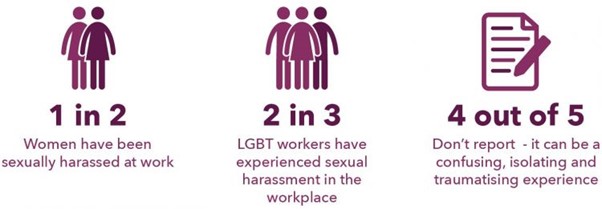
    Every day, people across the UK are sexually harassed at work. Our current laws put the onus on individuals to report such incidents but the TUC report that 4 out of 5 don’t feel able to tell their employer.


    UCU/Ed Support Sexual Harassment Helpline

    Call 0800 138 8724 or email support@edsupport.org.uk further information on the helpline can be found here.

    Local Points of Contact for Staff with Sexual Harassment Concerns

    Two members of the local branch committee have agreed to be points of contact for staff with sexual harassment concerns. Marie Hanlon (primarily for staff in professional services) and Sue Hignett (primarily for staff in academic departments). Their contact details can be found here. Please do get in touch with either of the contacts if you have any concerns regarding sexual harassment.

    Campaign for 16 days in 16 ways

    From the 25th Nov until the 10th Dec UCU are contributing to a campaign run by The Centre for Women’s Global Leadership, a feminist human rights organisation. For more information please see the UCU website here. Members who wish to get involved in organising and contributing to this campaign on a local level please get in touch with the branch by clicking here.

    Continuing Professional Development

    We are offering members a webinar course “Challenging Sexual Harassment and Violence” at a date TBC. Our branch Equality Officer has recently completed the pilot session for this webinar and reported back “It was an excellent session lasting just under 1.5 hours”. The course aims to help you; identify what we mean by sexual harassment and violence, understand how polices can protect staff and explore how we can all challenge sexual harassment and violence in the workplace. At this point we are requesting Expressions of Interest, please click here to send an EoI to the branch.

    LUCU Committee

  • Women’s History Month: Women across the world

    Women across the world

    Only 20 countries (10%) have women as Heads of State and Government. The United Nations call for “Women’s full and effective participation and decision-making in public life, as well as the elimination of violence, for achieving gender equality and the empowerment of all women and girls

    In the UK, we need role models in all areas of society.  An All-Party Parliamentary Group (APPG) Women in Parliament is running a series of discussions and debates about:

    • modernising Parliament to advance gender equality
    • amplifying the diverse voices of young women from across the country; giving them a seat at the decision-making table.
    • Call for Safe Spaces (part of UN Women): stopping the sexual harassment of women in public spaces, including online platforms

    During the COVID-19 pandemic women are facing increased domestic violence, unpaid care duties, unemployment, and poverty. Despite women making up a majority of front-line workers, there is disproportionate and inadequate representation of women in national and global COVID-19 policy spaces. 

    The UN has published a report on ‘COVID-19 and women’s leadership: From an effective response to building back better’ to shine a light on the critical role of women’s leadership in responding to COVID-19 and preparing for a more equitable recovery. It recognizes pre-existing and new constraints to women’s participation and leadership and advocates for measures to facilitate women’s influence over decision-making processes.

    This includes creating opportunities to ‘build back better’ by including and supporting women, and the organizations and networks that represent them, in the decision-making processes that will shape the post-pandemic future.

    LUCU Committee