Tag: Parking

  • Parking Charges Up 10x Faster Than Salaries

    You will by now have noticed the recent changes to charges for parking on campus.  Daily rates have increased for our members by around 20% – a stark contrast to the 2% pay increase offered by employers, and at a time when many staff find it more difficult than ever to park close to their workplace. 

    The changes were discussed with the campus unions before implementation – but as a matter of consultation, rather than negotiation, the University is under no obligation to change its plans.  This highlights the importance of the ongoing work to ensure that where we do have negotiation rights, these are understood and respected by management.

    When the first Car Parking Management Strategy, and first number plate operated barrier system, were introduced we were given assurances that parking charges were only levied to cover the costs associated with providing parking.  This position has apparently changed, and parking charges are now used as a revenue stream by the University.  As noted in previous communications, the maintenance fee for the new barrier system goes up by inflation as measured by the Retail Prices Index (RPI) each year.  RPI is usually higher than the newer Consumer Prices Index (CPI) and has been higher than sector wage increases for many years.

    While it is argued that the “actual” increases are small sums of money this trend, if continued, will see an increasing portion of our wages going back to the University until parking charges match wages.  Clearly this is not a sustainable model and the percentages are relevant.

  • Reminder: Two Opportunities to Help Shape Our Work

    Over recent weeks, we have been asking staff to share their views on two important issues affecting colleagues across the University: commuting and parking, and workload and working practices.

    Thank you to everyone who has already taken part and to those who are still planning to contribute – there is still time to make your voice heard.

    Please also encourage your colleagues and teammates to do the same. Every response helps us build a stronger evidence base and a stronger collective voice when raising issues with the University.

    Commuter Travel & Car Parking Survey

    Our Commuter Travel & Car Parking Survey is helping us better understand staff experiences and identify the solutions that have the strongest support across the University.

    The findings will directly inform the discussions we have with the University and help shape our wider campaign on parking and commuting issues.

    If you have not yet completed the survey, please take a few minutes to do so. The survey is open to all staff, regardless of union membership.

    Click here to complete the survey.

    Staff Workload and Working Practices

    Department Representatives have also been contacting colleagues to gather views on workload and working practices.

    We are keen to hear from staff across the University about:

    • What aspects of your workload have the biggest impact on you and your stress levels, and how these have changed over time.
    • What changes to ways of working would have the biggest positive impact for you, and what barriers stand in the way of those improvements.

    Whether you are a UCU member or not, we would welcome your thoughts.

    Please send your responses to ucu@lboro.ac.uk.

  • Have Your Say: Commuter Travel & Car Parking Survey Now Open

    Over the past few months, we have been building a collective response to the growing concerns around car parking and commuting at Loughborough University.

    We began by highlighting the likely impact of new student accommodation on parking capacity in Central and East Park. We then invited staff to share their experiences, concerns, and suggested solutions, and you responded in large numbers. Your feedback made clear just how significant these issues are for colleagues across the University.

    Now, we are taking the next step.

    Help Shape Our Demands

    We have developed a Commuter Travel & Car Parking Survey to better understand which solutions are most supported by staff.

    Your responses will directly inform:

    • The demands we take to the University
    • A forthcoming open letter, setting out these demands and inviting staff to show their support

    This is a crucial opportunity to ensure that our campaign reflects the views and priorities of staff as strongly and accurately as possible.

    The survey is open to all staff and should only take a few minutes to complete.

    Why Your Voice Matters

    Decisions about parking, commuting, and campus development affect us all, whether you drive, car share, cycle, use public transport, or combine multiple ways of getting to work.

    By completing the survey, you will be helping us to:

    • Identify the most widely supported solutions
    • Strengthen our position by providing additional details
    • Build a united, collective voice across staff

    The stronger the response, the harder it will be for the University to ignore.

    Please Take Part and Share

    We encourage to complete the survey today and to share the survey with your colleagues, in your teams and informal networks. The more staff who take part, the more representative, and impactful, our campaign will be.

    Click here to complete the survey, you can also copy this link to share the survey with colleagues.

    Together, we can ensure that staff voices are heard and that future decisions on commuting and parking are fair, sustainable, and workable for everyone.

    Thank you for your support.

  • Parking at Loughborough: What You Told Us and What Happens Next

    Members highlight widespread stress, inequity, and lost working time.

    Recently, UCU invited colleagues to share their experiences of parking and campus travel. We would like to thank the many members who provided extensive feedback on this issue.

    We received many dozens of pages of written comments from academic and professional services staff across multiple Schools and departments, representing a wide range of roles, contracts, working patterns and commuting circumstances.

    The message from these responses was clear: members feel that parking and campus travel arrangements have become significantly more difficult in recent years, and due to the new accommodation building project the situation is worse than ever.

    What Staff Told Us

    While experiences vary by location and arrival time, the vast majority of feedback we received suggested that the current system is:

    • Unpredictable: staff often do not know whether parking will take two minutes or twenty, with knock-on effects for scheduling and on-campus availability.
    • Stressful: many staff report starting the day more anxious or frustrated than was previously the case.
    • Inequitable: negative effects fall disproportionately on certain groups, such as staff with caring responsibilities; some colleagues reported additional childcare costs incurred simply to arrive early enough to secure parking.
    • Structural: linked to policy changes, reduced capacity, and insufficient alternatives.
    • Work Effectiveness: parking difficulties contribute to staff being late to teaching and meetings, lost time & increased preference for working from home (to avoid parking stress).
    • Safety:concerns were also raised about walking across campus after dark, congested roads and insufficient secure bike storage.

    Many colleagues reported that if they arrive after 9am, finding a space becomes significantly harder. It is common to spend 10–20 minutes or more searching for parking in high-demand areas.

    Recurring concerns in the feedback included:

    • Competition between staff, students, visitors, and external users.
    • Loss of nearby parking capacity and increased reliance on distant car parks.
    • Shuttle services that are described as unreliable or impractical, notwithstanding recently announced improvements.
    • Rising parking charges alongside worsening availability.

    What Staff Want to See

    The most common suggestions for practical improvements included:

    • Better management of student and visitor parking near workplaces and prioritising staff parking in high-demand areas. 
    • Improved distribution of staff-centred parking capacity aligned with where staff work.
    • More reliable shuttle services for cases when distant parking remains necessary.
    • Investment in active travel, including safer cycling routes and secure bike storage.
    • Consideration of longer-term infrastructure solutions where appropriate.

    Some colleagues emphasised sustainability and reducing car use overall. However, even these responses acknowledged that current alternatives are not yet reliable or practical enough for many staff.

    University Responses So Far

    Student parking is now limited to car parks 1 (multi-storey), 7 (Robert Bakewell), and Holywell, and this is enforced using cameras. A significant number of short-stay spaces by the swimming pool have been returned to normal use.  These measures have helped to ease pressure in East Park.

    We are told that problems are most acute Tuesday to Thursday during semesters 1 and 2.  Those who have the option are encouraged to help spread demand through the week by moving office days to Monday and Friday.

    Management are hopeful that the temporary car parks near Towers will become available again after a period of fair weather, however these will always remain weather dependent and so are not reliable, especially during semesters 1 and 2 when demand is high.

    We are assured that only on open days does the demand for parking outstrip the capacity on campus, and that there is always parking available, usually in the multi-storey and at Holywell Park. However, this clearly does not address the issue of the extra 40-60 minutes of travel time it would take to park at Holywell and travel to and from East Park if that were necessary, or the inequity around who this is likely to impact most.

    Management have been explicit in saying that this time spent travelling across campus does not count as working hours – meaning that individuals are expected to take a significant hit to their own time as a result of the recent changes.  This cannot be acceptable.

    Support for a Campaign and How to Get Involved

    While pay, workload and pensions remain core union priorities, many colleagues emphasised that parking problems are materially affecting daily working lives and supported UCU campaigning on this issue.

    We can work together to improve car parking, but more work will be needed to communicate the strength of feeling on this issue to management. If you would like to help shape next steps, please contact our Branch Organiser, Callum Salfield.

    Parking should not be a daily source of stress, inequity or lost time. Thank you again to everyone who contributed – and we will keep you updated.

  • New student accommodation and implications for parking in Central and East Park

    The LUCU Committee are supportive of plans for increasing on-campus student accommodation ready for academic year 27-28, comprising 5 new blocks and 552 beds.  There have been serious shortages of student housing recently, forcing some students to commute from Leicester and Nottingham – significantly impacting their enjoyment of being here.  We also know that on-campus accommodation is a popular part of the Loughborough Experience for students, and has been a crucial income stream helping to keep our financial outlook more stable than those Universities that cashed theirs in.  This sort of well-targeted investment contrasts with the sort of “vanity project” spending that other union branches blame for the dire situations being faced by their members.

    The new accommodation blocks will be built on many areas currently used for parking – especially car park 5, between our union offices and the walled garden.  While some extra parking will be provided close to Towers we will still be losing 120 spaces in an area of campus where colleagues already struggle, causing significant stress and lost time.  The new spaces are also classified as “temporary”, albeit without a known expiration date, meaning that we will likely lose them at some point when longer-term plans are made for the area.

    Management’s argument is always that there is sufficient parking on campus, and that the multi-storey and Holywell Park always have spaces.  While this is true, using these car parks when coming to Central and East parks will add significant travel time to cross campus, and necessitate use of very unpredictable bus services.  We do not think this is realistic or acceptable.

    We have been very clear that while the new halls are welcome staff should not bear such a significant cost to make them possible.  The University must also invest in sufficient parking for East and Central park.

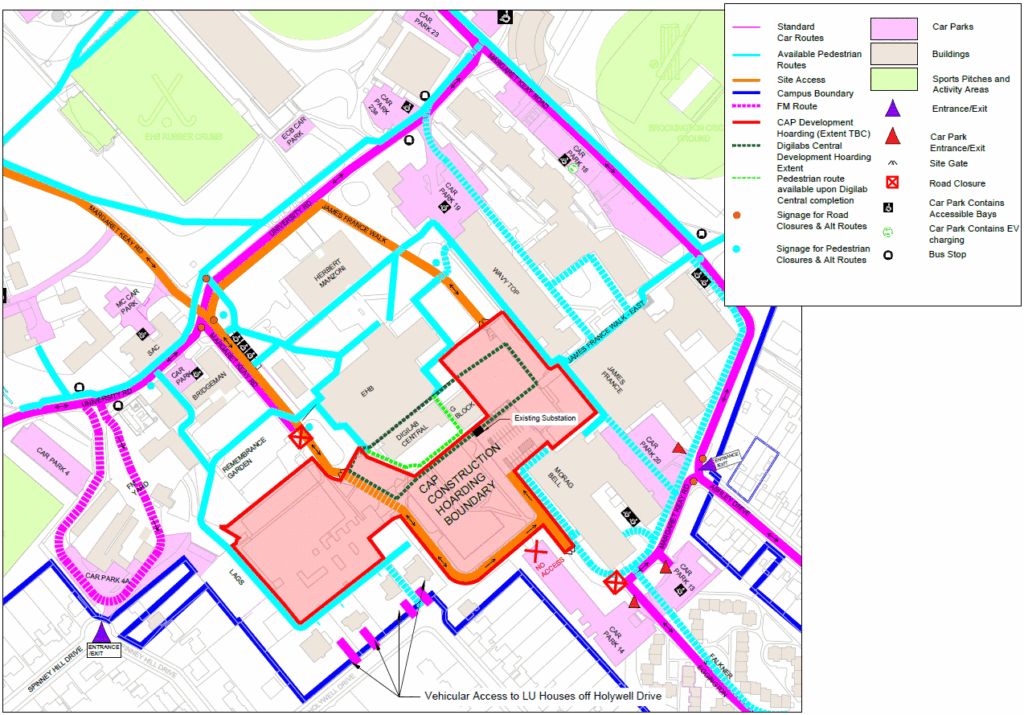
    The images below show an artist’s impression of the project, and the significant changes to campus roads which will begin in January, for the duration of the build, for your information.

  • Car Parking Update

    At the recent Joint Negotiating and Consultative Committee (JNCC), the three unions raised the issue of Car Parking under the new parking scheme.  Specific concerns were raised on behalf of members using Creative Arts and East Park car parks who were regularly unable to park close to their place of work.  In recognition of the issues, management agreed to create staff only parking areas and install barriers to check for bona fide visitors in these areas.  Monitoring of car parking more generally will continue, and we would welcome reports from members of any difficulties.

  • Car Parking Issues

    Parking overcharges

    We would advise all members to check their parking charges as members have reported being overcharged under the new parking system.  These issues have been resolved by the car parking company APCOA and refunds made.  Please use the tariff found here to check your charges and let the branch know if this issue has affected you by emailing ucu@lboro.ac.uk.

    Insufficient parking for staff

    We are aware that it has become increasingly difficult to find car parking spaces with some members reporting a 20 minute drive to find a space, followed by a 20 minute walk to be reach their destination. This issue has arisen since the public gained access to university parking.

    Next steps

    The branch has added ‘Car Parking’ to the next Joint Negotiating and Consultative Committee (JNCC) meeting agenda (24th April) where senior management issues raised by our members will be discussed and improvement the parking provision for staff agreed. If you have had any issues with car parking, please provide examples to the branch by emailing ucu@lboro.ac.uk.

  • LUCU News: August 2022

    Featuring news of the USS Governance Review, Covid-19, current campaigns and negotiations

    USS Governance Review 

    We are pleased to report that LUCU has been consulted by the University on the UUK-initiated review of USS governance. LUCU argued for early clarification of the review’s purpose; evaluation of the governing board’s composition and member competencies; formulation of clearer processes for recruiting and removing board members; assessment of the role of the ‘independent’ chair; channels for feedback from the scheme’s members, as well as employers, on reforms; better and more timely communication with members; and – crucially – the devising of a valuation process that is fit for purpose. We are pleased to report that these suggestions form part of the University’s response to the consultation.  

    Further, management confirms that they stand by the terms of our joint statement on USS, specifically regarding benefit restoration as preferential to lower contributions. Sadly, this remains a minority position among SMTs across the sector, but Lboro SMT continues to lobby behind the scenes to increase support, and a member of SMT will be standing for a position on the USS Employer Liaison Group, which will offer a wider platform for influence. The possibility of another joint LUCU-SMT statement remains an option as the review and the pensions campaign progress.   

    Covid-19 

    Covid precautions 

    Throughout Covid, LUCU has been campaigning for every protection possible for members, other staff, and students. Unfortunately, as precautions in wider society have been relaxed, we have found it harder to keep protections in place on campus. The University’s view is that if the precaution has been removed in the country at large (e.g. face coverings), then it cannot be imposed on campus. LUCU disagrees: we believe that we can continue to ask staff, students and visitors to take additional measures in the interests of public health.  

    Teaching spaces 

    All lecture spaces should have presenter positions that provide a natural separation from the other room occupants (usually 2 metres or more; where it is less than 2 metres, additional protections such as Perspex screens are available). This, coupled with the improved ventilation and CO2 monitors, means that teaching spaces should have a high level of protection from the risks of Covid. All teaching spaces should also have printed details at the presenter location of the room’s ventilation arrangements. If you find yourself in any locations where the information given is clearly incorrect (e.g. stating that windows should be opened where this is not possible), please get in touch with either the University’s Health and Safety department or with LUCU. 

    FFP2 masks 

    Where staff are concerned about additional risks (e.g. close working with students, visitors or other colleagues), then the University can provide FFP2 masks. These protect both the wearer and those around them. If you are interested in obtaining an FFP2 mask, please speak to your line manager in the first instance. LUCU recommends that FFP2 mask wearers undergo a Face Fit Test to ensure the mask is providing a high level of protection. 

    Lateral flow tests 

    The University has supplies of lateral flow tests and will continue to make these available to staff and students while stocks last. You may request LFTs here: You will be sent a QR code, and the tests can be collected from the Wavy Top building (at the rear near the steps leading to EHB) on presentation of your QR code or staff ID on Monday, Wednesday or Friday at either 11am or 2pm. This arrangement will be reviewed at the end of October.  Please continue to inform the University about a positive result, through the Connect and Protect service here.  

    At the start of term, students will be encouraged to test but will not be required to show proof of a negative result before coming on to campus. LFTs will be made available to all students on arrival, and through the scheme above for students who wish to test. LUCU believes that the University should test students on arrival, but management will not agree.  

    Contingency planning 

    Should the rate and severity of Covid infections increase to the point of posing a significant threat to staff, students and visitors, management has plans to reapply proportionately the precautions developed over the last few years. The University will also be purchasing a limited supply of flu vaccinations, to be made available to staff later in the year; please look out for details on the University’s news channels.  

    If anyone has specific concerns about Covid, Neil Budworth (Director of Health, Safety and Wellbeing) has offered to discuss these directly with staff: N.Budworth@lboro.ac.uk. LUCU is also happy to raise your concerns: please contact Alec Edworthy, our Health and Safety Officer, at A.Edworthy@lboro.ac.uk

    Campaigns

    UCU Rising 

    On 10 August, UCU launched UCU Rising, which follows on from the USS and Four Fights campaigns. This initiative focuses on the connection between pay, casualisation, workload, and USS pension cuts. Further details may be found here: https://www.ucu.org.uk/article/12469/FAQs

    All universities are to be balloted from the end of August on ASOS and strike action, and the results will be aggregated: therefore, any university where more than 50% of UCU members participate in the ballot and deliver a yes vote will be able to join the action.  

    The decision to ballot at this time was made by HEC in June, following a branch delegates’ meeting, at which LUCU was represented. However, the timing is not in line with the voting preferences expressed by delegates: a minority wanted an immediate summer ballot, but a majority favoured a later ballot to allow for recovery from previous actions and to enable branches to build support for further campaigning.  

    Branch officers will be attending a meeting chaired by Jon Hegerty, UCU Head of Bargaining, Organising, Campaigns and Education, on 17 August. This will offer an opportunity to ask questions about the rationale for an August ballot and other issues raised at the branch delegates’ meeting in June. We will organise an EGM once we know when the ballot will open.  

    Help up grow the branch!  

    We would appreciate members sharing the following social media recruitment posts via Facebook and Twitter. Due to the nature of social network algorithms, and with many of you being connected to other colleagues via these platforms, if members share these posts, they are more likely to be seen by colleagues who are not yet UCU members.  The bigger our branch the stronger our position to negotiate better terms and conditions for all staff!   

    Facebook post – please share  

    Twitter post – please retweet 

    Negotiations 

    Parking 

    Negotiations with management on parking charges has resulted in a fairer system, especially for those on lower pay. One sticking point remains, however: whether visitors will be charged. LUCU supports visitor charges as a way of raising income to subsidise further reductions in parking charges for the lowest paid and to encourage more environmentally friendly ways of travelling to campus. We can report that any new software system introduced will provide the University with the ability to charge visitors. While there is a general view that visitors should pay to park, this has not yet been translated into policy; therefore, we will raise the matter again at the September meeting of JNCC.  

    Fair pay 

    The branch is currently negotiating on behalf of members in SDCA to ensure that staff receive the appropriate pay for work being done as University Teachers, in line with the University’s own policy (see here). We have received broad agreement and co-operation from senior managers and are working to resolve the issues to the satisfaction of the members concerned. 

    LUCU Committee